

The Brief, Briefly
Some breaking news to break up your week

The Treading Water Economy: Why Stability Does Not Feel Like Progress
There is a growing disconnect between top-line economic stability and the reality of household finances. New polling data from YouGov gives that disconnect some useful shape.
Fifty-five percent of Americans say they are either just about keeping up or falling behind financially. Compared to the 21 countries surveyed, the United States ranks near the bottom on financial momentum. Only 34% say they are getting ahead or comfortably ahead.
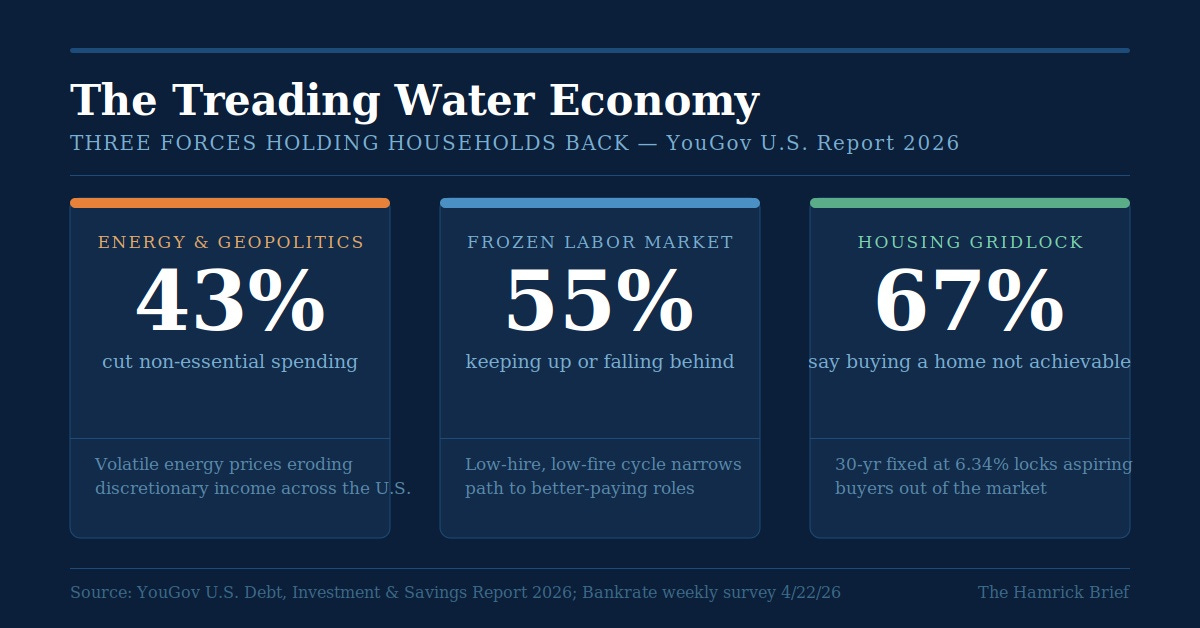
Three forces are doing most of the work here:
Energy costs are eroding discretionary income. Forty-three percent of Americans have cut non-essential spending in the past year. Twenty-four percent have cut essential spending.
The labor market is in a low-hire, low-fire cycle. Mass layoffs are not the dominant headline, but the path to better-paying roles has narrowed, limiting the ability to outearn sticky inflation.
Housing has become increasingly out of reach. With the Bankrate national average for a 30-year fixed mortgage at 6.34%, the YouGov data finds 67% of aspiring homeowners say buying a home is no longer realistically achievable.
As I’ve been saying for years, savings, or lack of it, is part of the picture. Twenty-two percent of Americans have no savings beyond what they need for regular expenses. Sixteen percent have drawn on savings to cover everyday costs in the past year. Among those with over $1,000 saved, nearly half say they would not invest any of it in the next 12 months.
Only 22% believe saving and investing will help them get ahead. When confidence in the basic tools of wealth-building erodes, the consequences extend well beyond individual balance sheets.
Two moves stand out as particularly useful right now. So, here are the action items to consider.
First, aggressively paying down high-cost credit card debt produces an immediate, guaranteed return. No market timing required.
Second, a high-yield savings account puts idle cash to work while building the emergency reserves that create flexibility when conditions shift.
The economy is not standing still. Household financial strategy should not be either.
The full YouGov U.S. Debt, Investment and Savings Report 2026 is worth reading. And if you are looking for a broader economic context each week, The Hamrick Brief weekly update publishes every Monday on LinkedIn and Substack.
Do you like this quick update?
Please share your thoughts and questions to me for future posts.