

Bad Habits, Bad Bets: How We're Self-Medicating the Vibepression
April 27, 2026

The Lead: Why Gambling Is Not Investing
“Neither a borrower nor a lender be,” Polonius warns in Hamlet, a man famous for dispensing advice nobody asked for. William Shakespeare, it turns out, did both and kept excellent records.
He left behind 37 plays, 154 sonnets, and a financial life that would hold up just fine today. He bought prime real estate, held a stake in his own theatre, and showed no hesitation in pursuing debts in court. The tension between timeless advice and real-world behavior is not new.
That tension is something we’re talking about in this week’s edition, too. While a generation reaches for financial shortcuts through sports betting and speculation, a classic investment principle still holds: own something, know what you own, and let time do the work. And, the house has always had the edge.
The Brief
The House Always Wins
The numbers are stark. The overwhelming majority of sports bettors lose money over time. For every dollar wagered on sports betting, some research suggests net investment in stocks and other financial instruments falls by more than two dollars. This isn’t bad luck. That’s the business model.
Liz Ann Sonders, Chief Investment Strategist at Charles Schwab, and Kevin Gordon, Senior Investment Strategist at Schwab, have put a name to something important. The rise of sports betting, prediction markets, and high-risk speculation is not happening in a vacuum. It is happening against a backdrop of what they’ve described as a “vibepression,” years of depressed consumer sentiment despite a growing economy and record household net worth. (I dealt in detail with the vibepression idea last week).
Eighty percent of Gen Z respondents in a recent Northwestern Mutual survey said they invest, or would consider investing, in high-risk or speculative assets because they feel financially behind. That feeling is not irrational. Affordability has become the defining financial challenge of this era. The traditional path to wealth-building can feel less like a ladder and more like a door that closed before you arrived. So people reach for the shortcut.
What they may not fully see is who is waiting on the other side of that bet. The platforms are engineered for engagement and loss. Unfortunately, celebrities lend credibility to products designed to extract money from some of the people who can least afford to lose it. Professional sports leagues and television networks have made gambling central to the fan experience: odds on the on-screen graphics, betting segments in the broadcast, and sponsorships woven through every level. Everyone in that chain profits from more wagering, not less. The only participant expected to lose is the customer.
Governments are all too willing to take their cut. States collected roughly $3 billion in sports betting tax revenue in 2024, on about $150 billion in total wagers, and both keep climbing. State budgets have grown structurally dependent on that revenue stream. The incentive to protect the bettor runs directly against the incentive to protect the budget.
The burden falls heaviest on financially constrained households, those with the least cushion to absorb losses. Credit card debt rises. Savings erode. The true cost is not the losing bet. It is the compounding that never happened, the future wagered away while every stakeholder in the ecosystem booked a profit.
In the spirit of disclosure, I had the privilege of working alongside Liz Ann on a panel in New York some years ago, and I appear regularly on Schwab’s streaming video news platform. She has built a remarkable career on trust and credibility, earned across decades and through every kind of market cycle. Her argument is worth amplifying: owning beats hoping, and discipline beats speculation. Those are not slogans. They are the facts behind financial resilience and well-being, and a rebuke to a system that profits from the absence of it.
Then & Now: April 23, 1616
Shakespeare’s Other Portfolio
Four centuries ago this month, William Shakespeare died at 52 and left behind not just the most celebrated body of work in the English language, but a quietly impressive financial record.
He left behind a will with precise bequests of real property, silver, and furnishings, the estate of a man who had never stopped paying attention to money. He was the opposite of a starving artist.
The literary reputation and the financial record rarely get discussed together. But, they should.
In 1597, near the peak of his theatrical career in London, Shakespeare paid 60 pounds for New Place in Stratford-upon-Avon, one of the grandest houses in town. He was 33 years old and buying real estate far from the city where he earned his living. That is not the behavior of an artist indifferent to the future.
The following year, with grain scarce across England, Shakespeare was recorded among those in Stratford holding malt in quantity during a shortage that was pushing prices higher. He was not the only one on the list, but he was on it. The poet of human nature was also, when the opportunity presented itself, a speculator in commodities.
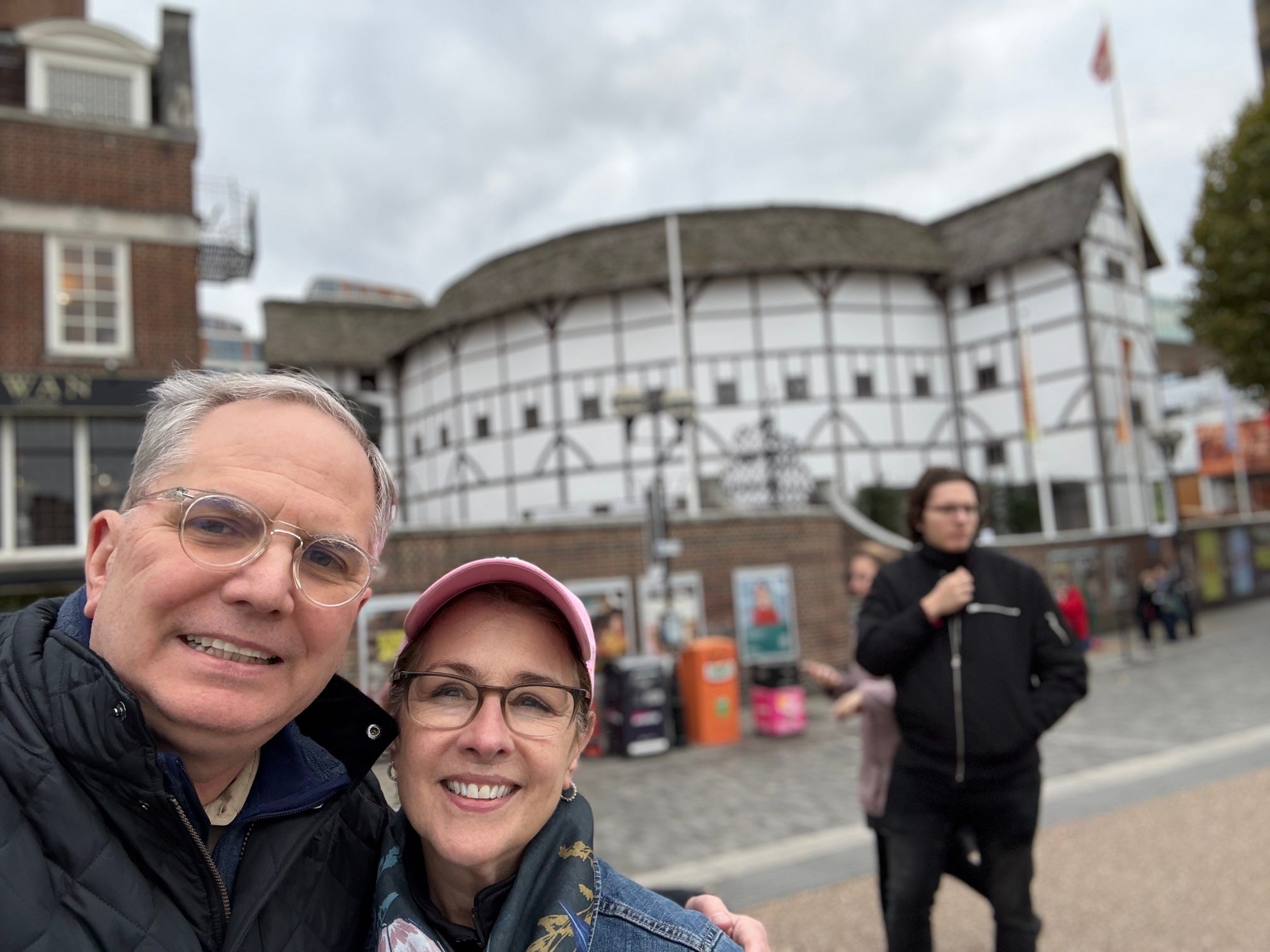
[PHOTO: Mark and Jeanne Hamrick outside the modern Globe Theatre, London, built in 1997. The third iteration of the building was originally constructed by Shakespeare’s acting company, The Lord Chamberlain’s Men.]
At the original Globe Theatre, which opened in 1599, Shakespeare held a small stake as one of the shareholders who owned the building itself rather than just the playing company. That generated income whether any given play succeeded or failed. He had positioned himself on the right side of the transaction.
He also pursued debts in court with notable persistence, suing a neighbor over 35 shillings in 1604 and pressing a separate case for six pounds in 1608 and 1609. These were not large sums. The point is that he kept track.
Creative people who understand the business side of their work tend to prosper. Those who leave the numbers to others often eventually discover that someone was not watching closely enough. Shakespeare watched closely. The plays endured. So did the estate.
You Asked
From Matt Willis via Substack (Matt’s a paid subscriber. Thank you, Matt, my friend going back MANY years to high school!)
Q. I’ve been reading about lots of Fed jobs disappearing. If that’s a good thing (pretty sure it is), does that mitigate the overall weakness of the job market?
A. Good question! Not in the way some might think, and in the near term, it’s actually the opposite.
When federal jobs are cut, those are still jobs disappearing from the economy. Government employment is part of total nonfarm payrolls, and when it declines, it subtracts from overall job growth just like layoffs in the private sector would. So, if the labor market is already showing signs of cooling, slower hiring, fewer openings, and amid rising caution among employers, federal job losses add to that softness rather than offset it.
There’s a second layer to this. Federal workers are also consumers. When jobs are eliminated, you don’t just lose payrolls, you lose spending power. That can ripple outward, especially in regions with a higher concentration of government employment, affecting local businesses and services.
There is a longer-term argument that a leaner federal workforce could improve efficiency or help address fiscal imbalances. But that’s a structural issue, not a cyclical or short-term one. The labor market responds to what’s happening now: hiring, wages, and demand, not to the promise of future deficit reduction.
To keep it in perspective: the federal workforce is relatively small compared with total employment, and changes there, while meaningful, don’t materially alter the trajectory of federal spending or debt on their own.
The bottom line: Job losses are job losses, wherever they occur. Right now, they reinforce labor market weakness, and don’t cancel it out.
(Note: Do you have a question? Please send it along, and we might include it in a future edition.)
Last Word
“Know what you own and know why you own it.”- Peter Lynch, legendary investor
Peter Lynch’s advice sounds simple until you test it: most people own assets they could not explain to someone else. Those who possess such understanding hold the prospect of avoiding bad, panicked decisions when and if the market moves against them. Lynch is best known for his work as portfolio manager of the Fidelity Magellan Fund, which became the world’s largest mutual fund during his tenure.